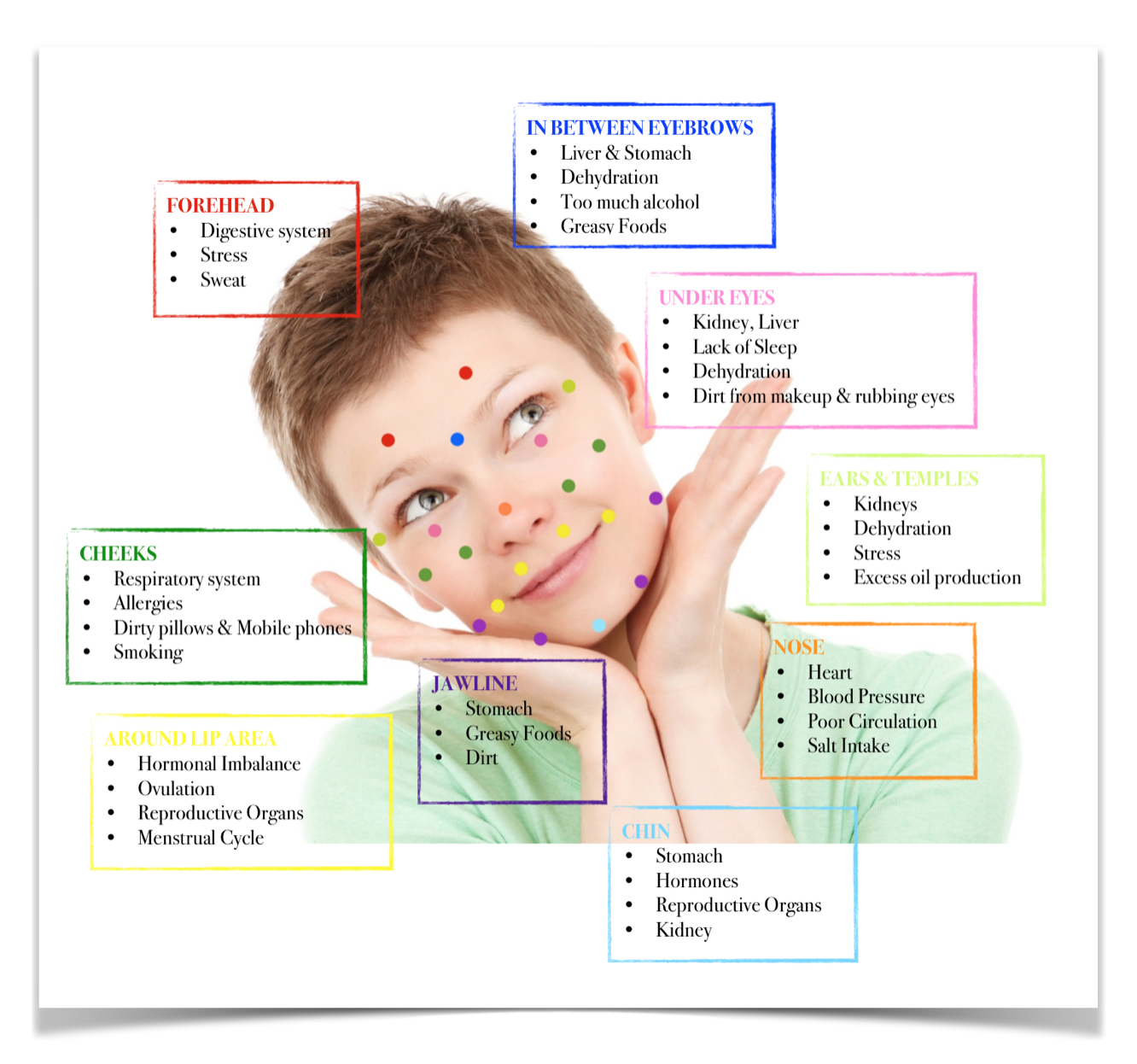
Face Mapping

Face mapping can be a really interesting way of understanding our skin as well as our body and mind as well. In modern medicine, we’re able to use tools such as blood tests, scans and x-rays to help inform us about what is going on inside of our body. However, thousands of years ago, diagnostic tools such as these didn’t exist and so people had to use other ways of finding out what was going on inside the body.

Ayurveda, the oldest successful healthcare system in the world, as well as Traditional Chinese Medicine (TCM) used to use face mapping widely in their practices because they believed it’s the skin’s job to communicate what is going on inside the body. With this knowledge, they could then be proactive in doing something about any skin symptoms, before anything became too serious.

That said, these practices are in fact still used in eastern medicine and are becoming more widely used in the west as well now. What’s most important to understand is this information is complementary, rather than an alternative. Therefore, it’s always advised that if you have any health concerns or symptoms, to seek medical advice and diagnosis…and use this information to further support a more balanced and healthier lifestyle.

So, looking at different parts of the face, let’s explore how these can relate to specific parts of the body. Let’s begin with the forehead area. If you experience poor skin tone here or perhaps it’s dull, has spots, lines or wrinkles, it’s said this can be linked to the gallbladder and the liver. To improve the look of this facial area, it’s recommended you reduce the amount of alcohol consumed, and better still eliminate it completely.

Further to this, it’s suggested to also consider the fatty foods you’re eating… what I mean by this are what are considered the bad fats, such as sugar, fast and junk foods and cooking less with oils, especially the really refined oils. We don’t need to use nearly as much oil as we do. In fact, I have been cooking without oil for some time now and it doesn’t make any difference to the overall flavour outcome of a meal. It does help to positively rebalance things in your body system though.

The next area is the space between the eyebrows. This is often linked to the stomach and the liver. So if this area is a place you tend to experience poor skin tone, lines, spots, then it’s really important you start to introduce foods, which are more cleansing into your diet. For example, more fresh fruits and vegetables and especially more fresh clean water…this is vitally important here.

Next is the temple area. Does this area get inflamed for you? Or maybe you get a lot of spots here?  If you answered yes, it could be an indication that your kidneys are not working as efficiently as they could. If this is the case, you may also notice that you’re getting back pain. Based on this, the advice is to drink more clean, fresh water, to help clean out your kidneys.

The upper cheeks. If this area is often prone to spots or symptoms like rosacea, eczema, it is most often linked to your heart. Therefore to help support this, integrate more good fats into your diet. Contrary to what you may think, this actually helps to break down bad fats in your body system. Foods to include could be oily fish such as sardines, mackerel or salmon, avocado, seeds and nuts…all of which help your heart health. Remember, it’s all about moderation though. This is not a cue to go and consume a whole bag of salted cashews or chocolate covered brazils or an entire bowl of guacamole in one sitting.

Your mid-cheeks are believed to be linked to your lungs and stomach, according to Ayurveda & TCM. So if this area is inflamed, lined or prone to spots, rebalance your diet by eating more alkalising foods. This includes vegetables, especially greens, fruits and green juices.  There are plenty of good guides to alkaline foods online…here’s one from Dr Axe.

The lower cheek area is linked to the liver and the stomach. So if the skin is poor around this area, it can be an indication that a gentle detoxification could help and support you…gentle being the operative word here. This doesn’t mean cutting out a whole list of things…it simply means reducing toxic foods such as sugar, alcohol, caffeine, too much wheat and too much dairy to help support the rebalancing of the skin around your lower cheeks.

Spots around the mouth area can often be an indication that the stomach is sluggish and perhaps even some mild food intolerances could be at play. So you may like to get this checked out, if you have symptoms around here.

For those of you whose jaw-line can often be prone to spots, this suggests there could be hormonal imbalances or a lot of stress going on for you. Anything you can do to reduce this stress and balance your hormones will help and support you. EFT is a great wee tool for these aspects, especially stress. As well as this, taking time to do something relaxing each day, be that meditation, walking in nature, breathing exercises, colouring in, yoga or whatever works for you, will make a big difference.

Lastly, if the skin around your neck is prone to spots or looks stagnant and dull, this is generally an indication that your lymph nodes need detoxing, which can also be linked to stress. So similarly, it’s important to take time out to relax.

This is just a very general introduction to face mapping and there is so much more which can be learnt from our skin and the various organs and tissues it’s connected to. As well as Ayurveda having a lot of guidance on this, META-Health is also a valuable and insightful guide and analysis tool for understanding what is going on with our skin, as well as all our other organs and tissues. Nothing works in isolation in the body system and a META-Health analysis can pinpoint root causes, especially when coupled with Ayurvedic knowledge.

Lastly, if you would like to learn about natural skincare and are looking for hand-blended vegan organic products, then check out UK-based Siskyn Skincare, who are award-winning and ethical, as well as divine on the skin. It feels like a facial every day I use their products. And no…I am not sponsored by them…I simply love their products and what they stand for in their business.

If you would like to know more about your own skin symptoms, do get in touch, where I will be happy to help and guide you on your wellness journey.

Our Organs & Tissues

I’ve needed to take some time out from being so active in my writing in recent months. The sudden loss of loved ones does funny things to your attention, priorities and focus…and so I’ve honoured this diversion, following its gentle guidance to nurture that which needed my self-care and caress…and it’s brought me all the way into February. 

I’m here now though, grateful and excited to embrace this new space and energy, which I’ve been introduced to in recent months, as a bittersweet bonus to the grief I’ve felt, as well as that freshness, which comes with a new year. 

And so I’d like to continue the discussion I began towards the end of last year, by sharing with you my third principal and domain to tune into for balanced health & wellness: our organs and organ tissue. It’s a pertinent place to continue this discussion, given that I’ve experienced grief recently, because we often feel the loss of loved ones very physically, such as in our heart or stomach. Which exact part of the organ is reacting, is the key question, however.

It goes without saying, that if we have uncomfortable physical symptoms, it’s wise to seek medical attention and diagnosis from our doctor as soon as possible. When we delay this action, we run the risk of symptoms becoming a lot worse and chronically debilitating…and no one naturally chooses this for themselves.

That said, it’s the root cause of these symptoms which I’d like to explore further…because, what many of us are not aware of is that not all symptoms are sympathetic in nature (i.e. when the body system as a whole is in a state of stress) as we’ve been conditioned to think and see illness and disease. Many symptoms are actually parasympathetic in their nature i.e. they are the body’s message to us that it is now doing its best to rebalance and regain homeostasis, after a phase of stress and would, therefore, like you to listen to it and oblige by resting and allowing it to do its job effectively, with appropriate support. Inflammation is a good example of this.

In the western health paradigm many of us live in, obvious stressors such as age, diet, exercise, accidents and injuries are explored and made accountable for many maladies which present themselves in the GP surgery or A&E wards. And when it comes to emergency medicine, the western approach is second to none in its life-saving treatments and procedures.

However, we’re seeing a growing number of symptoms showing up in patients and clients within this same medical system, which are given the autoimmune label or even cause unknown as the long term prognosis. Yet how can this be accurate? How can a whole body system, which is so sophisticated in its entirety, all of a sudden begin to turn on itself (such as in the case of autoimmune symptoms) or manifest symptoms, out of the blue, where a cause is not known?  As briefly mentioned in some of my own background, I refused to believe this notion as a young person, when given such a prognosis with vitiligo in my 20s. And as a result, I have since found out that it is possible to find the root cause of these symptoms, and so much more, when we understand that the body’s organs and tissues are not separate from the rest of the body’s biology, chemistry and physiology. Our brain, organs and tissues are all intricately connected…!

As much as it is helpful to have specialists in oncology, gastroenterology, cardiology, endocrinology and all the other -ologies in medicine, it’s time we recognised that none of the symptoms, which show up under any of these disciplines are operating as separate systems within the body. We have cells, which become tissues, which become organs, which become organ systems, which are part of the greater whole, that is the human body. And they have all evolved, according to the embryology of three germ layers within our body.

Each of these germ layers (endoderm – inner layer; mesoderm – middle layer; and ectoderm – outer layer) is connected to a part of the brain e.g. the brain stem, which is the first part of the brain to develop is connected to the endoderm layer. Thus, organs and tissue, which also develop in this germ layer will also be connected to the brain stem.

Knowing this gives us valuable clues when it comes to symptoms because each germ layer responds differently when in sympathetic or parasympathetic phases. Our emotions, beliefs and how we respond to subjective stress also impacts organs and tissue differently.

When I work with clients, I work integratively with a medical diagnosis, because it’s vital to know the exact origin of the symptoms I am exploring with my client. When I have this information about which organs or tissues are reacting, it informs me about the biological function of that part of the body…which in turn gives me vital insights into the thoughts and emotions likely being experienced to trigger this organ or tissue reaction. The more specific the diagnosis, the more accurate my analysis is i.e. it’s better to know it’s the epidermis layer of the skin with the symptoms, rather than just the skin because each tissue within an organ plays a specific role in its function within the body as a whole.

So think for a moment about the biological reason why we have the organs and tissues which function in our body as a whole…each part plays a vital and very specific role. It’s the logic of biology – it’s bio logical.

When we take the time to explore and understand our body’s biology and how our organs and tissues are reacting and responding in sympathetic and parasympathetic phases, we gain a very clear insight into the why of presenting symptoms. With this knowledge, we’re then able to determine specific stress themes, which are correlated with that organ tissue, its biological function in evolutionary and embryology terms, as well as the brain layer involved.

With this fundamental detail about the root cause of symptoms, we can then approach options for rebalancing the body system in a more informed and holistic way…as in truly rebalancing the whole person, in mind, body, spirit and social aspects. Without this whole-person approach, we’re missing the point of health and wellness in medicine, where it’s meant to be about supporting people to feel empowered and whole again.

So next time you have some sort of physical symptom, don’t just brush it off. Your body is talking to you…the question is, how well are you listening?

For more information about my work and how I can help you with your symptoms, get in touch now to begin taking back your power over your health and wellness journey.