How the Social Aspects of Life Impact Us

It’s not new news that aspects such as the air we breathe and water we drink, or relationships that bring us down or even the way we see ourselves in the socioeconomic climate all have an influence on our health and wellness and how we fair fundamentally when it comes to thriving or just surviving. 

Just this week, during a discovery consultation with a client, it was clear that social aspects of her life would dictate how she would proceed forward in being able to continue further work with me. She felt unable due to her socio-economic status and it was a stark reminder to me that basic needs are sometimes not even closely met by some people, as a consequence of their social standing, which has such a huge knock-on effect with the manifestation of symptoms in the mind and body.  

Poor living conditions in the home and environment, surviving on low incomes, unsupportive relationships and low standards of education can all be contributing factors to our health, vitality and wellness, from mental health issues such as paranoia to heart disease, respiratory ailments and skin complaints. 

Though our world has positively developed enormously even in the last 50 to 100 years, we have also seen a massive decline in the way our societies and communities operate and are structured, such as the decline in family units, which used to be such a massive support to each member, to help them thrive and achieve well. 

As a result, we’ve seen an increase in those who feel lonely, isolated, depressed, outcast and forgotten in our societies and communities…and from this, we’ve seen a greater number of physical and mental symptoms, which reflect these changes. 

Meta-Health approaches the health paradigm to include how these social aspects can and do influence our degree of vitality and wellbeing in its analytical process to find the root cause of symptoms so that a plan can be created for the individual, which supports and helps a rebalancing for them in their overall wellness aspirations. 

Research by Dr. Dean Ornish also proves that our ability to connect with ourselves and others and truly love ourselves and others does have a primary impact on our health and wellbeing, dictating how healthy we are or not, what makes us happy or down and out, or what helps us thrive, be healthy and vital or unwell.

On that social level, it’s important we remind ourselves regularly that we are all living energetic beings in an energetic living environment. Everything is intricately connected and impacted by the next thing. None of us are excluded from the fact that everything is energy, as Einstein taught us…everything, absolutely everything is connected. We cannot separate ourselves from it and so it’s important we learn to understand and move within it, to best support our health and wellbeing, so that we can all live our happiest and healthiest lives. 

We view the world, not as it is, but as we are…so it’s vital that we realise that what we think about, we bring about…what we perceive we achieve, whether we want it or not. 

“If you change the way you look at things, the things you look at change”.

~ Dr. Wayne Dyer

How it’s all connected. 

As discussed in previous posts about how our emotions and beliefs are also deeply connected to our organs and tissues and the symptoms they manifest, our social influences also play a part in our overall health and wellbeing. For example…

  • Upper Oesophagus Mucosa: You want to support your husband in his new business partnership, but instinctively know there is something fundamentally out of alignment with his chosen business partner…however, you have to live with your husband’s decision and choice anyway…but you just can’t swallow the idea and reality of it all and develop symptoms in your oesophagus. 
  • Bladder Mucosa: Your new neighbour has built a wall, which is clearly inside your property and boundaries and you feel as though your territory and boundaries have been overstepped, invaded, disrespected…and your bladder reacts with symptoms. 
  • Periosteum Innervation (nerves): You feel the pain and need of separation from a loved one, who has deceived you, so you want to kick them away…and you develop symptoms in your feet around the periosteum nerves. 
  • Vagina Mucosa: You discover that your wife or husband has been having an affair and feel the rejection sexually…and develop symptoms in your vagina. 

The power and influence of what goes on around us in our social environment cannot be underestimated and we need to start talking about this more openly and honestly, with ourselves and our health professionals. 

Do you live in a home where there are regular arguments, which make you feel inadequate or worthless? If so, is it worth exploring how to heal the relationships within this environment or move out? 

Is there a colleague who is constantly nipping at you, digging at you, making fun of you and putting you down? Is so, do you grow a thicker skin and buckle down with positive affirmations all around you, or change your workplace? 

Do you live in a community where you feel threatened, unsafe and like you always have to watch your back? If so, can you see if changing your view of this community will help or do you move to a new town, city or country? 

When we change, remove and create real-life solutions and soul-utions, we begin to see and experience powerful change within and around us as well. Anything is possible when we change the way we look at things. 

So what can we do? 

I for one can be a great procrastinator. I am the best cleaner, washer-upper and tidier when I want to avoid something which desperately needs and is calling for my attention. Like so many of us, I play games with myself, pretending and almost believing that things will get better if I don’t look at the problem…and as a result, my desire to engage with it grows more and more distant. The truth is, the issue is still there though and likely getting worse, the longer we ignore and dance around it, as if it’s some bonkers game of reverse hide-and-seek. 

I can fully put my hand up and admit that I have been and still am afraid to step outside of my comfort zone to deal with and look at some of my symptoms. It can be daunting. Eventually though, I realise that I need to help myself and the best way to do that is to seek help from another, who can support and guide me. 

This is what Meta-Health is all about…in the analysis process, together, we explore which specific social situation(s) is/are affecting your symptoms and then create a plan specific to you, to focus in on building real-life solutions and soul-utions. 

For example, what could be the social stressor triggering your knee pain? 

  • Is it your fear of moving forwards? 
  • Is it the stress you feel about being supported financially, when at this age, you feel you should be supporting yourself? 
  • Or, do you feel as though you are just not good enough? 

A client I have worked with in the past found his biggest light-bulb moment, in the entire healing of his symptoms, when he realised what his body was doing for him to help, protect and support him, even when his symptoms weren’t pleasant and how these symptoms were fundamentally connected to what was going on around him on a daily basis. 

Our body has an innate ability to regain homeostasis, balance, health and wellness, when we become aware of what is impacting us and we then create specific, individual plans to achieve our health and wellness goals.

It’s time we acknowledged that a one-size-fits-all approach to health and wellbeing does not work when we are all so innately different. No two people come to have the same illness or disease via the same stress triggers, so it makes sense that we all have individual plans to regain our health again as well. This is the backbone of Meta-health ~ it works with you as an individual, exploring what has triggered your symptoms, based on your life and its path, not a general paradigm or template, which hopefully will fit what’s going on for you. 

So where to from here?

Raising your awareness is key. When we understand just how sponge-like we actually are in our social environments, absorbing what’s going on around us, we can then take positive actionable steps to change things for the better. 

Improving the support, help and positive connections around you will create changes you didn’t realise were possible, as will increasing your self-love and the love you allow yourself to receive from others. 

Ask yourself these questions too and begin to positively shift things accordingly: 

  • How do your daily relationships at home, at work at play impact you? 
  • What could you change or let go from the above question?   
  • How can you shift your living, working and play environment so that it supports you more on every level?   
  • Who or what can you remove now from your life, who is simply not a positive influence at all? 
  • What other conscious action steps could you take, which would help improve your social environment for the better? 

If you would like further guidance, insights and personal coaching on how to improve your health, wellness and vitality, learning what has triggered your symptoms, please get in touch. Where this is a will, there is always a way. 

I offer a free discovery call, to explore how I can support you and your challenges, as well as session bundles for those ready to commit to change in their health and wellness journey. 

I also appreciate that it is a new and sometimes challenging concept for us to invest time and money on ourselves. I didn’t for years…until I found I wasn’t getting any better or enjoying life and how I was feeling…and then I changed my priorities about what was important to me…fashion and phones or health and wellness? 

It was a no-brainer for me because ultimately, I could have the former, when the latter was in balance and I felt like I had the energy and vitality to go out and be the best version of myself in what I do. I now love my life what I do on a daily basis and have enabled myself to make choices and decisions I wasn’t able to make when I wasn’t at my best in my health. 

Day one or one day…?
You choose. 
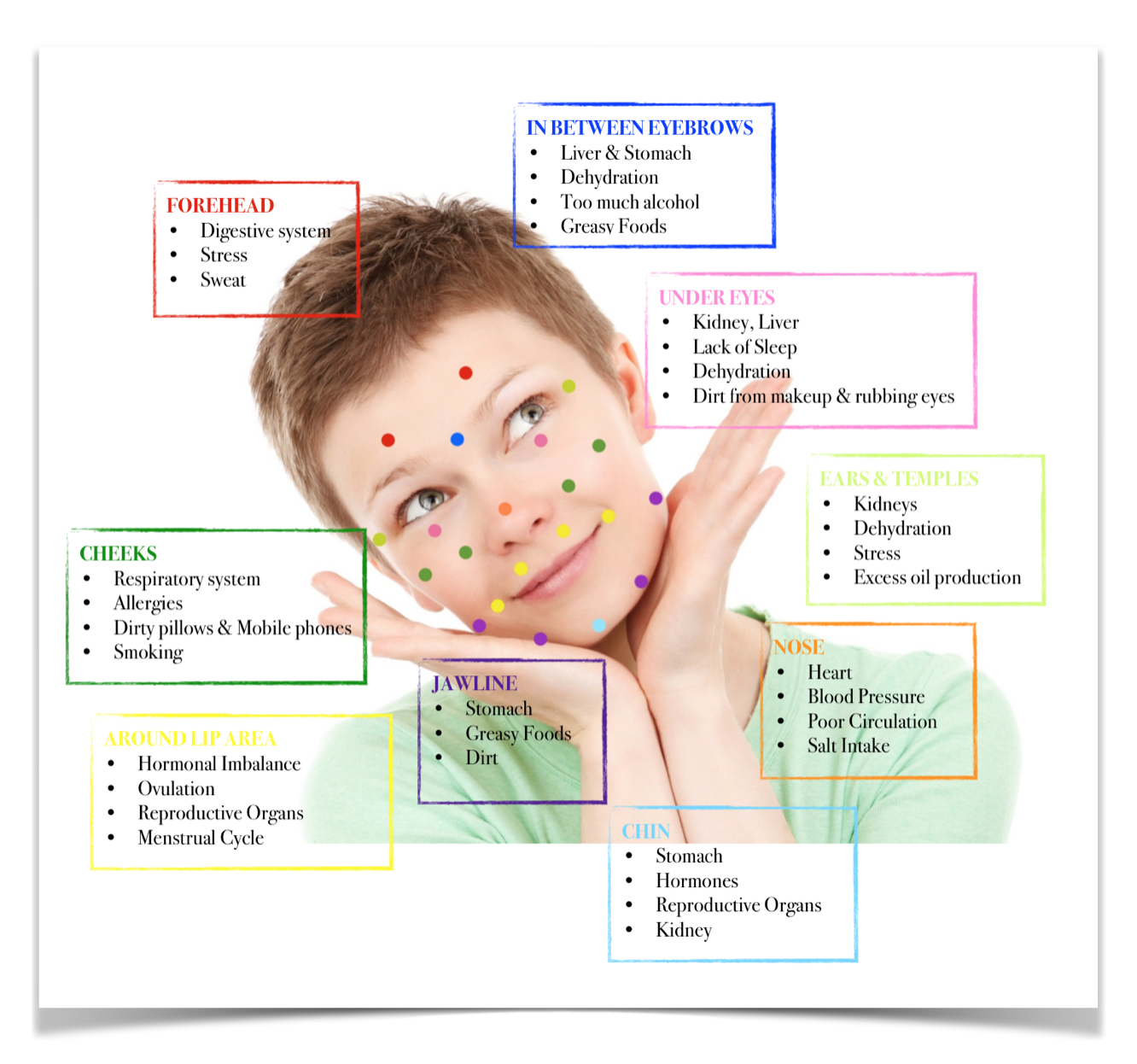
 

Face Mapping

Face mapping can be a really interesting way of understanding our skin as well as our body and mind as well. In modern medicine, we’re able to use tools such as blood tests, scans and x-rays to help inform us about what is going on inside of our body. However, thousands of years ago, diagnostic tools such as these didn’t exist and so people had to use other ways of finding out what was going on inside the body.

Ayurveda, the oldest successful healthcare system in the world, as well as Traditional Chinese Medicine (TCM) used to use face mapping widely in their practices because they believed it’s the skin’s job to communicate what is going on inside the body. With this knowledge, they could then be proactive in doing something about any skin symptoms, before anything became too serious.

That said, these practices are in fact still used in eastern medicine and are becoming more widely used in the west as well now. What’s most important to understand is this information is complementary, rather than an alternative. Therefore, it’s always advised that if you have any health concerns or symptoms, to seek medical advice and diagnosis…and use this information to further support a more balanced and healthier lifestyle.

So, looking at different parts of the face, let’s explore how these can relate to specific parts of the body. Let’s begin with the forehead area. If you experience poor skin tone here or perhaps it’s dull, has spots, lines or wrinkles, it’s said this can be linked to the gallbladder and the liver. To improve the look of this facial area, it’s recommended you reduce the amount of alcohol consumed, and better still eliminate it completely.

Further to this, it’s suggested to also consider the fatty foods you’re eating… what I mean by this are what are considered the bad fats, such as sugar, fast and junk foods and cooking less with oils, especially the really refined oils. We don’t need to use nearly as much oil as we do. In fact, I have been cooking without oil for some time now and it doesn’t make any difference to the overall flavour outcome of a meal. It does help to positively rebalance things in your body system though.

The next area is the space between the eyebrows. This is often linked to the stomach and the liver. So if this area is a place you tend to experience poor skin tone, lines, spots, then it’s really important you start to introduce foods, which are more cleansing into your diet. For example, more fresh fruits and vegetables and especially more fresh clean water…this is vitally important here.

Next is the temple area. Does this area get inflamed for you? Or maybe you get a lot of spots here?  If you answered yes, it could be an indication that your kidneys are not working as efficiently as they could. If this is the case, you may also notice that you’re getting back pain. Based on this, the advice is to drink more clean, fresh water, to help clean out your kidneys.

The upper cheeks. If this area is often prone to spots or symptoms like rosacea, eczema, it is most often linked to your heart. Therefore to help support this, integrate more good fats into your diet. Contrary to what you may think, this actually helps to break down bad fats in your body system. Foods to include could be oily fish such as sardines, mackerel or salmon, avocado, seeds and nuts…all of which help your heart health. Remember, it’s all about moderation though. This is not a cue to go and consume a whole bag of salted cashews or chocolate covered brazils or an entire bowl of guacamole in one sitting.

Your mid-cheeks are believed to be linked to your lungs and stomach, according to Ayurveda & TCM. So if this area is inflamed, lined or prone to spots, rebalance your diet by eating more alkalising foods. This includes vegetables, especially greens, fruits and green juices.  There are plenty of good guides to alkaline foods online…here’s one from Dr Axe.

The lower cheek area is linked to the liver and the stomach. So if the skin is poor around this area, it can be an indication that a gentle detoxification could help and support you…gentle being the operative word here. This doesn’t mean cutting out a whole list of things…it simply means reducing toxic foods such as sugar, alcohol, caffeine, too much wheat and too much dairy to help support the rebalancing of the skin around your lower cheeks.

Spots around the mouth area can often be an indication that the stomach is sluggish and perhaps even some mild food intolerances could be at play. So you may like to get this checked out, if you have symptoms around here.

For those of you whose jaw-line can often be prone to spots, this suggests there could be hormonal imbalances or a lot of stress going on for you. Anything you can do to reduce this stress and balance your hormones will help and support you. EFT is a great wee tool for these aspects, especially stress. As well as this, taking time to do something relaxing each day, be that meditation, walking in nature, breathing exercises, colouring in, yoga or whatever works for you, will make a big difference.

Lastly, if the skin around your neck is prone to spots or looks stagnant and dull, this is generally an indication that your lymph nodes need detoxing, which can also be linked to stress. So similarly, it’s important to take time out to relax.

This is just a very general introduction to face mapping and there is so much more which can be learnt from our skin and the various organs and tissues it’s connected to. As well as Ayurveda having a lot of guidance on this, META-Health is also a valuable and insightful guide and analysis tool for understanding what is going on with our skin, as well as all our other organs and tissues. Nothing works in isolation in the body system and a META-Health analysis can pinpoint root causes, especially when coupled with Ayurvedic knowledge.

Lastly, if you would like to learn about natural skincare and are looking for hand-blended vegan organic products, then check out UK-based Siskyn Skincare, who are award-winning and ethical, as well as divine on the skin. It feels like a facial every day I use their products. And no…I am not sponsored by them…I simply love their products and what they stand for in their business.

If you would like to know more about your own skin symptoms, do get in touch, where I will be happy to help and guide you on your wellness journey.

How does Stress work in the body?

In this fourth post about the main contributing factors to our health and wellness, I’d like to talk about stress and how it works in our body and mind.

We all experience stress to a greater or lesser degree. No one is immune to it throughout life. The main difference in how stress impacts and affects us as individuals, is how we respond and ultimately process stress, which we experience in our everyday lives.

A certain amount of stress is actually beneficial to our overall health and wellbeing at times, giving us a boost or surge of energy, motivation and inspiration, to help us get through something like a deadline at work or a test. However, prolonged chronic stress can create more serious health challenges, including having an impact on the cardiovascular, immune, neuroendocrine and central nervous systems.

Further to this, as you may recall from my previous post about how emotions impact our health…prolonged stress can impact these emotional responses as well, bringing about a debilitating sense of self in both physical and psychological ways. While we can all generally manage some simple stress triggers, by tapping into our bodies natural ability to cope, prolonged chronic stress can and does have serious implications upon our overall wellbeing in the long term, if left unchecked.

Stress is our natural inbuilt response to an experience, which to us as an individual, felt threatening or challenging in that moment, either physically and/or psychologically. Our hypothalamic-pituitary-adrenal (HPA) axis and autonomic nervous system are the major aspects of our body, which react to stress, which we, as individuals, feel is threatening, by activating the fight-flight-freeze-fawn response via our sympathetic nervous system – the part of our body, which pushes our entire system into stress, in an effort to keep us safe and survive the threat, be it real or perceived.

The body and some of its major systems may remain in this state of sympathetic activity for some time if we do not or cannot switch off the stress trigger.  This is when we see chronic symptoms begin to manifest. However, when we are able to reduce or eliminate the root cause which triggered our stress response in the first place, the parasympathetic nervous system then takes over, moving, calling, guiding our body into a recovery phase, which may include feeling more tired, hot and hungry than what is considered normal. This is simply a natural response and symptomatic of the body regenerating itself, in an attempt to return to a state of homeostasis…i.e. balanced health and wellness again.

How does stress work in the body though…?

It isn’t new knowledge that traditional, long-standing, ancient paradigms of health and healing all acknowledge the mind-body-social-spiritual connection and the way in which different types of emotion and mental imbalances take root in different parts of the body.  Indian Ayurveda and Traditional Chinese medicine are two of the more well-known disciplines, which explore these connections, as well as other ethnic-based traditions found in Africa, Asia, and the Americas.

The foundational beliefs of these traditional disciplines (which have been successfully used for over 2500 years) are that every organ and tissue in our body correlates with the same vibration or energy of specific emotions, which we may feel at any given time.  Therefore, it stands to reason, that every symptom, be it physical or mental, which creates an imbalance in our body, putting it into a state of dis-ease, develops from an emotional stress trigger, which is connected with a specific organ or tissue, creating a block or disruption in the normal flow, for optimal functioning to happen.

A domino-type effect can then begin to occur if symptoms are not dealt with in the immediate moments, days and weeks following a stress trigger. This is when we see symptoms changing from being acute (short-term) to chronic (long-term). This can potentially add further stress to the mental and emotional psyche of the individual, thus multiplying the overall stress on the mind-body…and a whole myriad of other symptoms can begin to grow and emerge, feeling like it’s spiralling out of our control.

Big ‘T’ traumas such as earthquakes, major accidents, fires, floods and divorce can all cause incredible stress and left unchecked, can contribute to existing symptoms, as well as manifest new ones. Small ‘t’ traumas can equally contribute to existing symptoms and because they’re small, we often ignore the significance of them. However, like a slow dripping tap, over time, they too can contribute to chronic symptoms.

Stress, be it a big ‘T’ or little ‘t’, is something, which to the individual, felt unexpected, dramatic and isolating and you had no strategy at that moment to deal with and handle what was happening. We call this a UDIN. It’s a very subjective experience…therefore no two people respond the same way and thus, no two people came to have their symptoms from the same stress trigger.

These events or stress triggers can begin when we’re children and become conditioned responses, such as a comment or look we received from a parent, teacher or bullying in the playground and they can also happen as adults, with major events such as those described above.

Whatever the original trigger for the UDIN moment, because we’re all subjective individuals, with our own conditioning and background, the pattern and process our own biological programming will follow through it’s sympathetic and parasympathetic phases will depend on how we’ve perceived the UDIN. For example, a child who’s told she can’t play football because she’s a girl may take this personally and feel devalued, thus impacting her muscular-skeletal system. Whereas another child given the same comment may feel like their territory is being invaded, thus impacting their bladder.

The key point to remember is that stress does not come from just one source, such as a major event like an earthquake. It can be cumulative over time as well, such as that condemning comment from a parent or teacher…which is then reignited by a boss or spouse later in life and so it goes on and on and on, thus reopening the old unhealed wound again and again and again and keeping the body in a fight-flight-freeze cycle of stress, whenever that button is pushed.

These conditioned responses form beliefs and over time, we become entwined in an unconscious cycle of stress, whereby specific organs will react with the corresponding brain relay and related emotions are all retriggered. This on-going cycle ultimately forms symptoms, which can and do become chronic. Knowing the root cause of these life-long response patterns, as well as the big T events, can help us detect where symptoms have stemmed from and inform us in a more specific and individual way to create a plan for changing patterns, behaviours and emotions. This ultimately allows the body to complete its own natural process of healing, through this deeper understanding and empowerment of us as individuals.

There is a lot we can do on our own to take back our power and reduce stress in our lives. Here are some ideas to get you started:

  • Learn to meditate to quieten your mind. InsightTimer is a fantastic free app with loads of guided meditations to get you started. I would advise beginning with guided meditations until you know you feel 100% comfortable with a silent practice. Seek out a certified teacher for more specific guidance and disciplines. After many years of exploring and trying out different styles and approaches, I now personally practice Transcendental Meditation (TM), which has been a life-changing addition to my daily self-care routine, since I began practicing it several years ago.
  • Spend time in nature. Research now shows us that time in nature is very healing for our overall wellbeing. The Japanese practice of Shinrin-yoku, which loosely translates as forest bathing, has become a cornerstone of preventive health care and healing in Japanese medicine. The beach is also a very powerful space to de-stress from those daily grinds. Simply kicking leaves in the park or getting outside can be all it takes though, to change your state of being. So get outside and breath in some of those positive vibes.
  • Move your body. Whatever your ability, movement will help. Find what works for you and commit to it. The best movement activity for you is the one you do regularly…so experiment and try some things out. There is so much to choose from these days, from high-energy HIIT classes to slow motion yoga and everything in-between. So find the one which gives you that high and go for it. You’ve nothing to lose except the stress you don’t want anyway.
  • Journalling. For those who like words…writing things down can help. I’ve been a journaler for many years and when I am consistent, it helps heaps. One resource which I found helpful was the simple morning pages practice described in The Artist’s Way by Julia Cameron.
  • Find your tribe. Community and a sense of belonging are so important to us as humans, in order for us to thrive. With the age of technology, many of us find that we’re a lot more isolated however, even with the social media platforms of our day. So I’d encourage you to seek out your face-to-face tribe so that you have people who are on the same page as you, who cheer you on when you need that extra support, motivation and inspiration. We don’t always get this from our biological family…so I like to see these groups of people who form our community as our soul family…they get you and accept you for who you are, no matter what.
  • Where possible, eliminate the stress triggers, which you can control yourself. And set boundaries, which support you to maintain a stress-free space for yourself.
  • Breathe. So often when we are in stress, we actually forget to breathe normally. So take the time to sit and take some slow deep breaths in through your nose and out through your mouth, while placing your hands on your heart. You will soon notice yourself calming down and feeling a sense of peace again.  The Heart Math Institute continues to do extensive research on how some simple breathing with your hands on your heart can help with more balanced heart coherence. See their website for some free resources.
  • And if all this seems a bit too much to manage on your own, then you can also book a discovery call to see how working with me can help and support you on your journey towards balanced health and wellness again.

“It is not that stress kills us, it is our reaction to it” 

~ Hans Selye